Average Reviews:

(More customer reviews)Panasonic USA does not offer this particular version of the GF1 which means these are most likely European cameras.The camera industry calls cameras imported through unofficial channels Grey Market cameras.Before buying a grey market camera there are things that you need to know about them.
The first, and most important, is that Panasonic USA will most likely not perform any warranty work on the camera if it breaks.I am not exactly sure what Panasonic's policy is on Grey Market cameras but Nikon USA will not perform warranty work nor will they perform paid work on Grey Market cameras and lenses.A possible solution to this is to buy an extended warranty.
If these cameras are European models then they should work pretty nicely.The one difference that I know about is Europe has some crazy law that requires cameras to only recored for 30 min.That is the reason the Canon 5D MkII has its 30 min limit.Panasonic "region coded" their cameras so the Japan and US market GF1 don't have this limit.The European models do.For me this won't not be a deal breaker.
I don't think anyone would sell the Japanese versions here but if these are Japan versions then you cannot change the language.The outside of the camera looks the same but the menus, I believe, are Kanji.(I don't read Kanji but I am pretty sure that it is Kanji and not one of the other 2 "alphabet" systems they use here in Japan.
Please talk with the Seller before purchasing so you are fully aware of any warranty limitations and camera the limitations before purchasing.
I think it is awesome that they are selling these cameras as you can't get them through official Panasonic USA channels and there are some pretty nice options in other parts of the world.Some of these options are as follows.The White GF1 is the #1 selling GF1 in Japan.Also, a few years back, Leica sold a White limited edition of their M8.2.That camera still sells for a premium.I am not suggesting to pay a premium.The additional color options are Red and Grey.My wife really likes the red.There is also a kit that includes the camera but no lens.We can probably expect to see this in the US in the future but for now this is the only way to get this.Also, I don't think the color versions of the G1 sold that well in the US so I don't know that the colors will be coming to the US through Panasonic USA.I think Ford and his Model T in any color as long as it is black has ruined us.
Now that you know what you are getting into with these cameras, my review for them begins below.The one comment I will make up front is that even thought these are great cameras, they are overpriced at their MSRPs.So anything over MSRP is way way overpriced.Additionally, the price of the GH1 started falling right before Christmas.If the same pattern follows you can expect to see the GF1 at $700-$750 by Mar or Apr.
Bottom line up front:The elusive compact camera with interchangeable lenses, DLSR Image Quality, DSLR Focusing speed and DSLR performance has finally been made.It is the GF1.
I live in Japan so I have been lucky enough to have been playing with this camera since 18 Sep.This camera sold out on the first day from Bic Camera in Japan so it is going to be hard to get a hold of one.Please be aware that this camera is "region" coded so if you buy a Japanese version you will not be able to change the menu language to English.
This review is equally applicable to both versions of the GF1.I personally prefer the 20MM (40MM equivalent) f1.7 lens to the 14-45MM (28-90MM equivalent) f3.5-5.6 lens for the following reasons: 1)Since the m43 is relatively small compared to a full frame sensor you need a fast lens to get shallow depth of fields.2) As a fast lens it is far more usable in low light situations.This lens is ~2 to 3.5 f stops faster than the 14-45MM lens.What this means is that given a certain situation, if you were to select the same shutter speed you would let in 3.5 more light allowing the use of a lower ISO setting or you could set a 3.5 times faster shutter speed to allow you to prevent motion blurring.3) This lens is smaller so it makes the camera eminently more portable.What you give up is the ability to zoom with your hand.There is a work around for this and it is called zooming with you feet.However, in confined situations, you may not be able to move back are far as you need to.If this is the type shooting you routinely do then the 14-45MM zoom is probably for you.For me, and I believe for most people, I like the great flexibility the faster lens gives me and I am not usually constrained by space.Additionally, the 20MM lens, in my non-scientific tests, appears to focus faster than the zoom.Both focus fast but the 20MM feels faster.STILLS
This camera along with the G1 and GH1 has the best contrast detection autofocus on the market.It is as fast if not faster than my Nikon D40 and is almost as fast as my D700.This is a great technological breakthrough and is what allows the camera to be smaller than a DSLR while giving nearly identical performance.With this camera you will not miss photos of your children or other fast moving subjects while you wait for your camera to focus.Bravo.
On top of the great focusing performance , this fresh design allows this camera to handle exceedingly well.In many ways it takes the best of the point-and-shoot (P+S) world and mixes it with the best of the DSLR world.It doesn't have as many dedicated buttons as my D700 but the Q Menu system works very well and allows for quick changes of most shooting parameters.There is a detailed menu system but I don't find myself using it very much while shooting.I feel that this setup allows photographers moving up from the P+S world to feel immediately comfortable on this camera while also giving experienced photographers the control they need to work their craft.It seems many reviewers find fault with the Panasonic one control click wheel that changes aperture and shutter speed (other cameras have two wheels or have a button and 1 wheel combination).I actually prefer the click wheel on this camera.With the other types of setups (which I have on the D700 -- two wheels and D40 -- 1 wheel plus button) I usually have to look away from the scene to find the other wheel or button.With the setup on this camera my finger is already close by the wheel and I just push it to change functions.
I don't know what kind of plastic Panasonic uses on this camera but I love the way it looks and feels.Also, I think having a red, white, or grey camera is cool (unfortunately only available in black in the US.The G1 was available in multiple colors but so far the GH1 and GF1 are "available in any color as long as it is black.") and this combined with its size makes it look more like a "consumer" camera rather than a "professional" camera.With the photographer unfriendly laws proliferating the world, it is nice to have an incredibly capable camera that doesn't look like a professional camera.
This is a micro-4/3s camera system.That has some pros and cons.The chip is smaller than most DSLR chips.A full frame (FX in Nikon speak) sensor is ~860 sq mm, a Nikon DX sensor is ~370 sq mm, the 4/3 sensor is ~225 sq mm, and the typical sensor used in a point and shoot range between ~25-50 sq mm.However, a 2/3 sensor like many TV shows are shot with is ~60 sq mm and a 1/4 sensor like most home video recorders is only ~10 sq mm.What does all of these numbers mean?From a "stills" perspective the 4/3 format is relatively small when compared to DSLRs.That means that for the same megapixel rating, the 4/3 sensor will have smaller photoreceptors and that means more noise.However, the 4/3 sensor is roughly 60% of a DX chip so while this is a great physics discussion, in real life you will not be able to tell the noise difference based on sensor size even with a picture blown up to 100%.This is born out by the GF1's excellent noise control up to ISO800.You can also still use shots taken at ISO 1600 and 3200 but those low light shots are usually better turned into black and whites for that noire grainy look.That is the "downside" (not really much of a downside especially when compared to the up side) of the micro 4/3 system.The upside is that because you have a smaller area to cover, you can make lenses smaller (less weight and less cost).You also get a 2x multiplication factor on your lenses.So now that 200mm lens gives you 400mm of reach.Yea.However, a down side of the 2x multiplication side is if you want to shoot wide.You need a 7mm lens to get a 14mm viewing angle and those can get pretty expensive (panasonic makes are really nice and small 7-14mm that is more expensive than this camera).The point of all of this mumbo jumbo is that this camera takes great pictures and the lenses are smaller than DSLR lenses.Less weight and smaller size with no practical image quality compromise equals great camera.
On thing that is a negative is the slow 1/160 flash sync speed.This will be very limiting for off camera flash during bright light.With such a slow sync it will be exceedingly difficult (impossible?) to get shallow depth of fields while lighting.Most people probably won't use this feature but for those that do it will be a bummer. (Super FP mode and ND filters can help with this though)
This camera, also, does not have in Camera IS.The IS is in the lenses.The reason that Canon, Nikon, Panasonic do this is they say on-lens IS performs better.From what I have seen that is a true statement.However, in camera IS is better than no IS.Also, this camera can mount lens from numerous other systems.None of those...Read more›
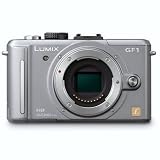
Click Here to see more reviews about: Panasonic Lumix DMC-GF1 12.1MP Micro Four-Thirds Interchangeable Lens Digital Camera (Silver Body)
Product Description:
Capture 1280 x 720 HD video in AVCHD Lite format for longer recording time. 4/3-type 12.1-megapixel Live MOS sensor; clear images even when taken at high ISO sensitivity. Full-time Live View; new My Color mode. Capture images to SD/SDHC memory cards (not included)

Want to buy Panasonic Lumix DMC-GF1 12.1MP Micro Four-Thirds Interchangeable Lens Digital Camera (Silver Body) at other amazon sites? Click the corresponding icon below:


0 comments:
Post a Comment